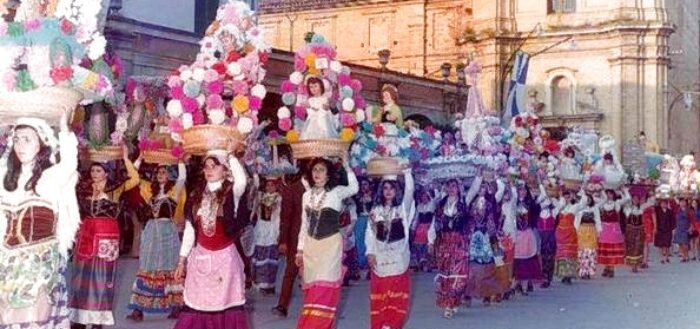
[Images 1 and 2] – During the week between 18 and 25 May in Bucchianico, in the Province of Chieti, there takes place a re-enactment of the legend of St. Urbano I the Pope, patron of the town, whose intervention saved the citadel from the siege of the troops of Chieti. The folk festival tells through images the stories and the chronicle of that time, as it was passed on by the ancient wisdom of the local folk culture.
[Image 3] – In the early stages of the event the parade re-enacts the exodus from the countryside towards Bucchianico fortified borough and the entrance into the town of the countryside people who lived outside the walls to ask for protection. [Image 4] – The characters enter the borough with clear allegorical forms and objects drawn from the peasant and shepherds’ world of the area. In order to endure the siege, the characters representing the peasants bring into the citadel foodstuffs and other items from the countryside, and seek protection from the Sergentiere. Baskets, chests, pots and other embellished containers are metaphors of the agricultural world, whose main feature is the creativity of folk culture.
[Images 5 and 6] – It is mostly the women that parade up to the village square, where the “ciammaichella” takes place, a kind of dance similar to a carousel of forms and colors to the music of folk instruments, that intertwine on the stage of the square in a seemingly endless parade. This is exactly the “ciammaichella”, suggested by St.Urbano to the Sergentiere – the commander of the civic troops – which discouraged the army of Chieti from continuing the siege since they were led to believe that the borough was armed and defended by a numerous army.
[Images 7 and 10] – In the parade also the wagons follow one another, richly decorated and representing scenes of the everyday activities of the crafts culture: the carpenter’s workshop, the oven, moments of sheep-raising, the copper workshop, the farmhouse, the pub locals, ans so many other workshops (showing provisions and tools to be protected) as a sign of solidarity of the crafts guilds and the unity of the town called by its quarters and hamlets to oppose the invaders.
[Image 8] – The picture of St. Urbano can be seen emerging from the wagon, to represent bread, the fertility of the land to be safeguarded and protected. [Image 9] – A lady prepared a basket with images representing a team of oxen plowing a plot of land, driven by a peasant: a powerful symbol of sharing the cultural identity of a richly agricultural area, engaged to preserve the memory of the past also through these simpler symbols.









 Articoli per il quotidiano IL CENTRO


 Il Passaggio nell'Arcolaio, Storie