The article was first published in December 2001 by Vincenzo Battista.
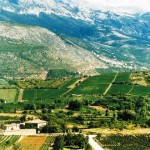
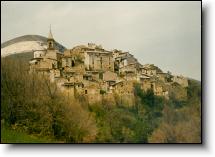
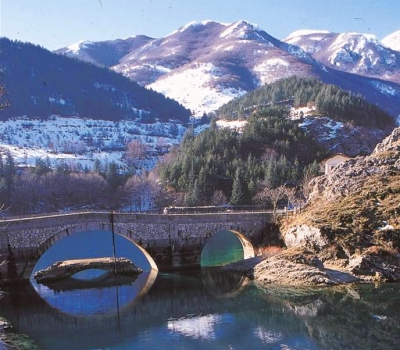
Leggi la versione italiana: Quelle serpi avvolte intorno alla statua del SantoCocullo, in the Province of L’Aquila, is at 870 meters a.s.l., along the railway line connecting Sulmona to Rome. The village rises alongside Mount Luparo (1327 meters) “The valley opening in front of the village is surrounded by bare rocks, while on the other side, to the south, snow-capped mountain crests follow one after the other…”
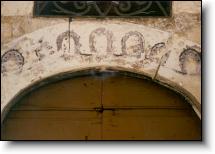
The horseshoe marks above the door of a house in Cocullo commemorate the St. Dominick’s female mule, the protagonist of some of the miracles inspired by the Saint. Myth and religion are the two sides of one same story. In a nearby area called “Via del lupo” (Wolf’s Path), the oral tradition says there is the impression left by the knee of St. Dominick, who knelt down on the spot to recite his prayers.
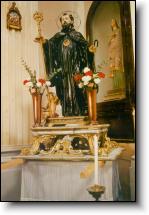
St. Dominick the Abbot lived in the 10th and 11th centuries AD. Born in Foligno, in the Umbria region, he started his pilgrimages, preaches and ascetic practices in Central Italy, making miracles recorded by word-of-mouth traditions. He died on 22 January 1031 and was buried in Sora.
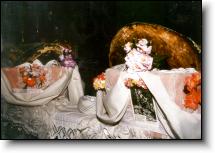
Sweet bread pancakes are sold in an auction, to receive the offers of the faithful: they will be on show during the procession with the statue of the saint enveloped by live snakes. In a context of deep belief in the themes of folk religion traditions and especially in St. Dominick the Abbot, the local community reasserts through the yearly rites taking place on the first Thursday in May the authority of the Saint’s figure, the majestic relevance of the event.
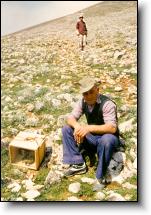
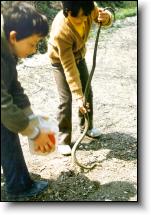
Cocullo snake charmers are over with their snake hunting. They proceeded through the areas called Valle Marzia, Vrecciara, Vipone, Valle Cuta, Antera and Scastielle. Once they locate the snake, they catch it first with a stick and then by the neck. Traditionally the snake’s teeth are extracted using the rim of an old hat.
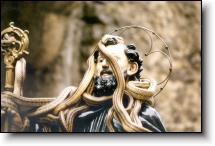
During the procession on the first Thursday in May, before the snakes are placed all over the statue of St. Dominick, they will be fed with milk kept in containers with crusca. It is the snake that, most of all other elements, expresses an ancestral myth: the unknown aspect and unpredictability of the natural environment with man’s innate need to achieve the dominance on his own habitat.
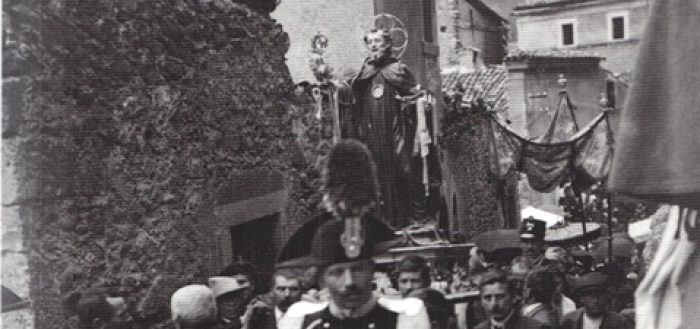
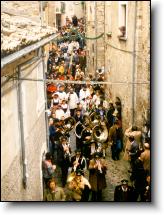
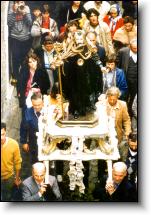
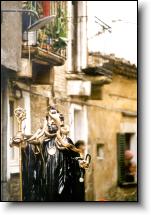
The procession with St. Dominick’s statue all covered with live snakes through the borough of Cocullo. In the words of Giovanni Pansa, a historian from Sulmona: ” The show offered by St’ Dominick’s procession is most frightening. The viewer’s mind is almost paralyzed by what appears before them, filled with awe and repugnance for that blind, repulsive, savage belief in the souls of the good, simple Abruzzese people”.
The snakes envelope the saint, move and proceed all over the wooden statue, take up different positions. All around the procession the public is speechless. The only sound is the clicking of cameras taking thousands of pictures that will be shown once back home, becoming an unusual “cult object”. Wolf hunters, snake charmers and healing saints make up the psychological space where the population of Cocullo and the whole Sagittario valley draw their certainty that they will not be ruled by evil’s blind forces…
Snakes and wolves were the emblems of Italic peoples like the Marsians and Irpinians. Some areas in Abruzzo, especially in the Sagittario valley, were under the menace of wolves and snakes, which for the local populations represented the uncertainty and anxiety of their existence that, together with the precariousness and hardships of life, were almost unbearable. Therefore the community adopted such magical-religious rites (namely the snakes enveloping the Saint’s statue) in order to perform the function of a symbolic protection of the whole territory through St. Dominick’s “healing power”.
One of the key elements connecting the past and present is definitely the snake myth that gives Cocullo its present character as a cultural island. A kind of devotion in the whole universe of human behaviors coming from a psychological need connecting the snake myth and the saint’s celebration.
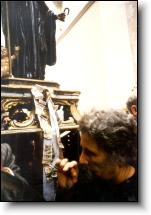
The believers approach the statue, touch it, kneel down, pray; some hang banknotes over a colored ribbon fixed to the pedestal of the statue. The men of the celebration committee come in the front: the believers are moved away, the procession cannot be stopped. The devotion that for centuries kept St. Dominick’s myth alive in Cocullo is nowadays perceived as a tourist event which is superimposed and almost covers the spiritual core, so narrow today, where the deep meanings of the saint’s cult and snakes are still present.






 Articoli per il quotidiano IL CENTRO

 Il Passaggio nell'Arcolaio, Storie