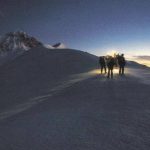
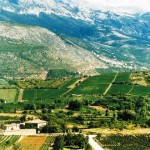
The photos (taken by Lorenzo Nanni) show the final moments of the procession, which lasted for several hours, now almost at the church of St. Erasmus. Two processions started from Beffi and Succiano, two hamlets of the municipality of Acciano, passed through the “Santissimo” valley, then climbed over the “i calmi” and crests of the mountain of Sant’Erasmo (1303 meters a.s.l.) whist divides the Middle Aterno Valley from the Navelli Plain. The area, where once all kids of beans and cereals were grown, is blessed by the priest walking at the front of the procession. The standards and the two statues of the saint are carried through a very rugged terrain, and every little while the soil is blessed, to ask for good harvests, according to the folk tradition. The three standards (the blue one for the Madonna di Loreto; the white one for St. Anton; the red one for St. Erasmus), as well as the saint’s statue, are carried in turns by the people of Acciano.
This is the statue of St. Erasmus of the people of Beffi.
The celebration of a Mass before the church of St. Erasmus with the two statues of the saint from Beffi and Succiano is a sign of the peace finally achieved between the two communities that for centuries used to fight for right of way rights along the “path of St. Erasmus”, a right that was finally granted to Beffi.
The offers of the pilgrims.
St. Erasmus is one of the “helping” saints whom Catholic people pray on special needs. The cult seems to take origin from Germany in the 13th century, and spread throughout Central and Southern Europe. The pilgrimage in the Acciano area takes place on the first Sunday in June.
The relic holder in silver contains bone fragments of St. Erasmus. The procession leaves from an altitude of 700 meters and clibms up to Mount Offermo (1303 meters) to finally reach the sanctuary which rises at 1165 meters after many hours. According to the tradition, the sanctuary rises on the spot where the saint rested during a visit to Abruzzo.
The church of St. Erasmus was built in the 16th century, possibly on a previous chapel, also built in honor of the saint, and still shows some locals used in the bast by shepherds for shelter. In the small chapel there is a stone altar, carved into a niche and a fresco showing St. Erasmus, who is also prayed for bowel disorders.
The blessed loaves are offered before the church as a sign of devotion. Once taken back to the homes, popular belief says that they, if placed outside the windows, can avoid thunderstorms and hail from destroying the harvest.








 Articoli per il quotidiano IL CENTRO

 Il Passaggio nell'Arcolaio, Storie