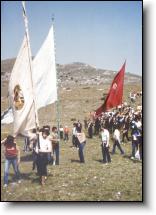
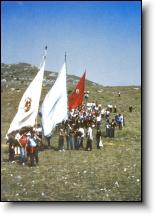
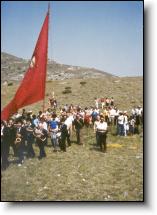
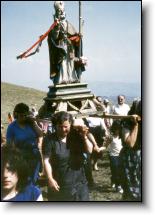
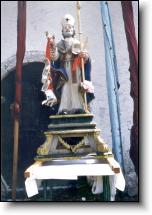
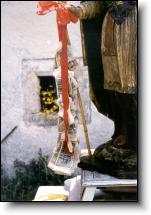
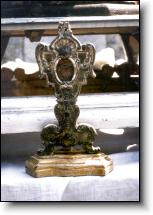
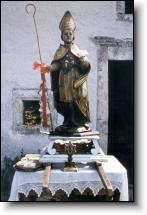
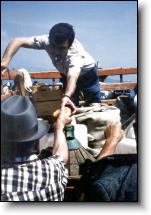
The photos (taken by Lorenzo Nanni) show the final moments of the procession, which lasted for several hours, now almost at the church of St. Erasmus. Two processions started from Beffi and Succiano, two hamlets of the municipality of Acciano, passed through the "Santissimo" valley, then climbed over the "i calmi" and crests of the mountain of Sant'Erasmo (1303 meters a.s.l.) whist divides the Middle Aterno Valley from the Navelli Plain. The area, where once all kids of beans and cereals were grown, is blessed by the priest walking at the front of the procession. The standards and the two statues of the saint are carried through a very rugged terrain, and every little while the soil is blessed, to ask for good harvests, according to the folk tradition. The three standards (the blue one for the Madonna di Loreto; the white one for St. Anton; the red one for St. Erasmus), as well as the saint's statue, are carried in turns by the people of Acciano.
Nelle fotografie, realizzate da Lorenzo Nanni, è documentato l'ultimo tratto della processione durata diverse ore e giunta nei pressi della chiesa di Sant'Erasmo. Partita da Beffi e Succiano, frazioni di Acciano, la processione ha superato la valle del "Santissimo", ha poi risalito " i calmi" e le coste di Sant'Erasmo ( m.1303 s.l.m.) che divide la media valle dell'Aterno dalla Piana di Navelli. La zona, coltivata un tempo con legumi e cereali, viene benedetta dal sacerdote che precede il corteo religioso. Gli stendardi, insieme alle due statue dei santi hanno attraversato un paesaggio impervio, segnando così il territorio che di volta in volta viene benedetto per propiziare i nuovi raccolti agricoli, secondo gli intendimenti della tradizione popolare. I tre stendardi (azzurro, la Madonna di Loreto; bianco, S. Antonio; rosso Sant'Erasmo) vengono portati a turno dalla comunità di Acciano insieme alla statua del Santo.